For B2B firms that sell expertise, projects and proven experience.

Your next projects are already sitting in your own files.

NateSystem connects the projects you have delivered, the accounts you already know and the know-how held by your team, then puts one loop into production: reactivating an account, preparing a bid, or deciding earlier. Within 90 days you run it in-house, or we run it for you.

See how it works

In ten days you leave with three accounts to contact and, for each one, the reference to show them and the message ready to send. If not, we keep going at our own cost until you have them.

Trusted by
  • Vendéglátás Menedzsment, cabinet de conseil
  • Institut Les Chartreux
  • Université Jean Monnet
  • Chromosome
  • Aloess
  • SimpleTeam
  • Goutagny Élagage
  1. 1Structure the knowledge.
  2. 2Put it to work.

Connecting your sources costs the same work whatever you do with them afterwards. So the engine gets built once, and everything laid on top of it draws on that same foundation.

Layer 1Built once

The data engine

Your delivered projects, studies, proposals, CRM and conversations are indexed and tied back to their deal, their client and their date. The engine answers questions in plain English, citing the document and the page. Your teams stop hunting for the file, re-entering what already exists, and chasing each other to find out where things stand.

See how it gets built
What the engine gathersYou own it
CollectionDocuments, CRM, inboxes, shared drives · wherever they already sit
AttachmentEvery item tied back to its deal, its client and its date
IndexingA question in plain English, an answer that cites its sources
90 days

Layer 2Laid on the engine

The execution layer

The file on a deal, assembled before you open it. Content drawn from your own studies, not written alongside them. And the analysis that looks through the deals you won for the pattern that repeats, so it can say which companies and which people to approach. Then the message goes out on LinkedIn or by email, written for that person. Nothing leaves without your review, and the conversation it opens is yours.

See what sits on top
What runsYou approve, you close
PreparationThe file, the content, the targeting · all drawn from your sources
ApprovalThirty seconds per output. Nothing crosses that line without you
ClosingThe conversation it opens is yours, from first reply to signature
Who runs it

We run it for you, or we train your team and you take it over: code, accounts and data in your name, on a standard stack.

Not sure what your own knowledge could produce?Book a 30-minute call

Un seul compte. Cinq réponses.

Ask “where do we stand with this client?” inside your own firm. Depending on who you ask and which tool they open, you get five answers. None of them is wrong. None of them is enough to decide.

HubSpotSalesCRM
Status “client”. Last activity: March 2024.
Never synced
SharePointProjectsSharePoint
Thermal survey delivered on two buildings, December 2024.
No owner
The only real linkThe engineer who ran the deal
« Ah oui, eux. Ils ont changé de directeur technique l’an dernier. »That exists nowhere but in his head.
Stays in the thread
ExcelDeal trackerExcel
Two rows, an amount, a date. Margin left blank.
Margin unknown
OutlookManagementOutlook
“They wanted us to come back on phase 2 in the spring.”

The problem is not producing more information. It is finding it connected, at the moment a decision has to be made.

A tender lands. So does the countdown.

A few days to decide whether you bid, a few weeks to write it. You decide with what you manage to dig up, not with what your firm actually knows.

  1. The triggerThe brief lands

    A scope, a deadline, a client. Nobody yet knows whether you have already handled something comparable.

  2. The days that followYou go and ask the people who know

    Who did something close, at what price, in how long. The answers exist: spread across six tools and a few people’s heads.

  3. And you have to decideBid, or let it go

    With no way to compare against what you have already delivered, the call gets made on instinct. So you bid on almost everything.

Every week you redo work your own firm has already done. That is money left on the table, every single day.

You already have the material. What it lacks is a foundation.

Connecting your sources costs the same work whatever you do with them afterwards. That is why it only gets done once, and why everything that comes after no longer has to redo it.

WHAT YOU ALREADY HAVECRM312 accounts · 47 opportunities184 WITH NO NEXT ACTIONHubSpotSalesforceDELIVERED PROJECTS1,240 files · since 2011NEVER LINKED TO THE CRMBusiness ERPShared drivesSTUDIES AND PROPOSALS3,880 documentsNOT FINDABLE BY SUBJECTMicrosoft WordOneDriveDRAWINGS AND CALCULATIONS620 CAD · BIM filesTIED TO NO DEALCAD · BIMMicrosoft ExcelTHREADS9 years of email and meetingsOUTSIDE EVERY TOOLGmailTeamsKNOW-HOW9 senior engineersKNOWN TO ONE PERSON ONLYWhat the experts knowRAG & REVENUE ENGINEAI LEVERAGE · HUMAN JUDGMENTSTRUCTURE6 sources6 sourcesThe foundation: linked, dated, attributed, sourcedCapitalise4 uses4 usesDecide1 use1 useReactivate1 use1 useAcquire5 uses5 usesStreamline2 uses2 usesLES BOUCLESTHIRTEEN USES · ONE FOUNDATIONCAPITALISEPrepare a bidFind a precedentGather the material for a responseBack up a priceDECIDESee what is slipping before it costsREACTIVATEPick an account back upACQUIRETarget accounts that look like yoursRecognise a pattern that repeatsWrite every approach for the personKeep the relationship warm over timeDraw content out of your studiesSTREAMLINECentralise internal requestsOpen a portal to your clients
What the foundation makes possible

More than 150 possible uses on this foundation, within the same five loops. The thirteen above are a sample. We build one: the one that matters most in your firm, chosen at the Diagnostic.

  • Capitalise
  • Decide
  • Reactivate
  • Acquire
  • Streamline

The machine prepares, your teams decide, and we are the ones who build it.

We build the system on your own data.

The system
Gathers the context, finds the precedents, cites its sources and proposes an action with the reason behind it. It sends nothing and chases nobody.
Your teams
Approve, correct or discard: thirty seconds per output. Nothing crosses that line without approval from someone on your side.
NateSystem
Builds the system on your own data, and fixes it when it gets things wrong. Then you take it over, or we keep it running.

No new tool to adopt, no extra interface to open. We build the system on the ones your teams already use.

NateSystemHubSpotOutlookWordExcelTeamsSharePointLinkedInSlackNotion

We do not touch your expertise. We make it compound.

Ten days to know. Thirty to see it running.

The Diagnostic decides in ten working days, and one of its outcomes is to build nothing at all. If you go ahead: a first version on day 30, tested against reality by day 60, and on day 90 you take it back or we keep running it. Every milestone says what you know coming out of it.

  1. Days 1 to 10

    The Active Value File.

    Years of projects filed by client, that nobody opens again. We establish what, inside them, can still do work.

    Days 1 to 10Ten working days · two weeks
    1. D1Kick-off meeting, scope confirmed
    2. D1–D3Collection and targeted interviews
    3. D4–D6Analysis of the two sources and their quality
    4. D6–D8Prototype, business case, blueprint
    5. D10Read-out, and a decision between three outcomes
    What you hold on day 10

    The Active Value File · Eight pieces

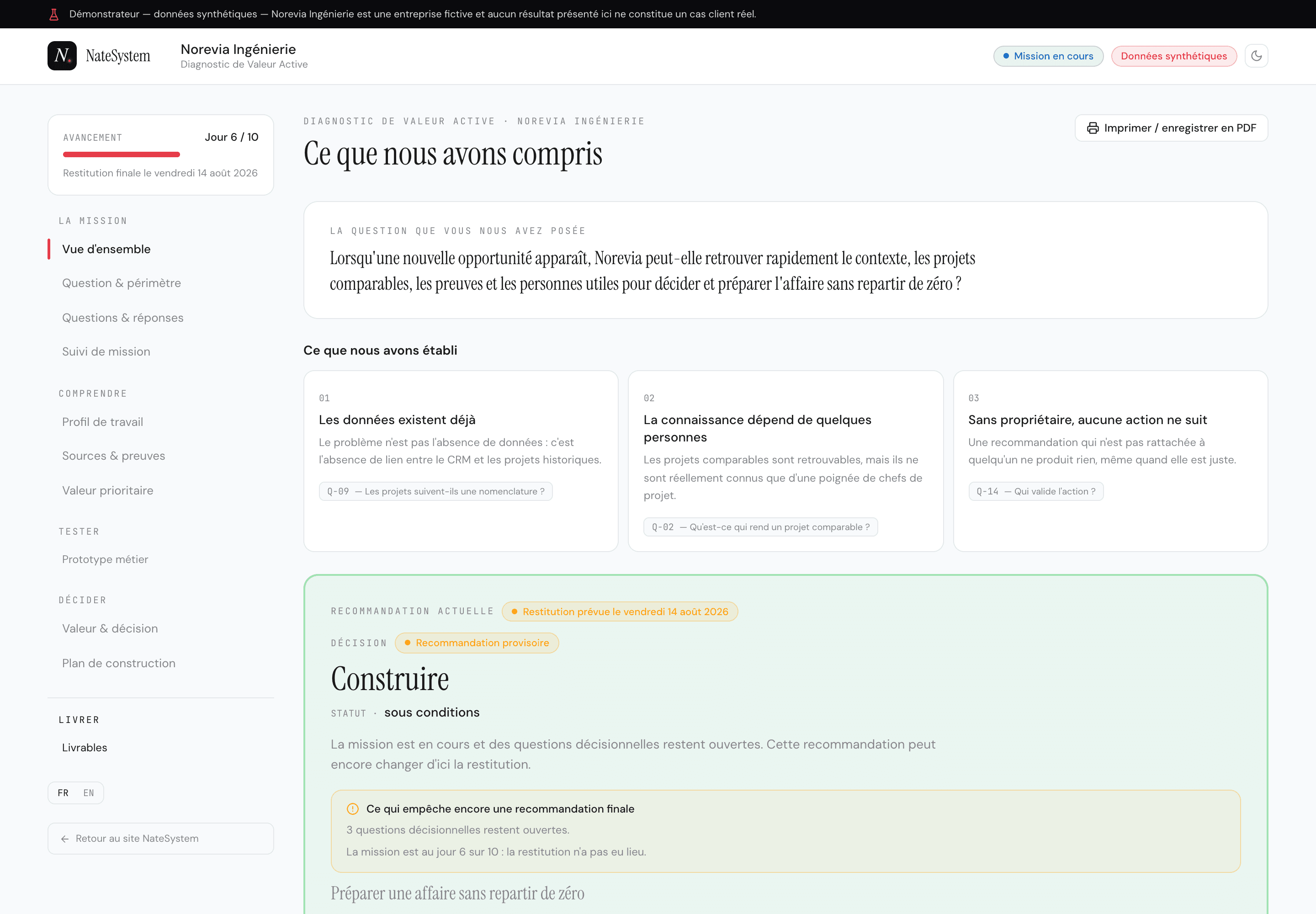
    Diagnostic client space · overviewAperçu · données synthétiques
    Overview of a Diagnostic: the question asked, three established findings, progress at day 6 of 10 and the provisional recommendation.

    A decision file, not a report: the prototype can be handled, the business case can be argued, and the acceptance criteria bind what comes next.

    See the services

    We analyse, we cost it. At the read-out, you decide.

  2. Days 11 to 30

    The first version gets built.

    A consulting report stops at the recommendation. Here it becomes a dated scope, one you can refuse before we build.

    Days 11 to 30Three weeks, inside the 90-day engagement
    1. D11The executable scope is settled
    2. D11–D14Sources, access, and each side’s responsibilities
    3. D14–D20Operating rules and acceptance criteria
    4. D20–D30First version of the system
    • Sources connected and datedExcelOutlook
    • Scope and criteria written down
    • The first version runs

    We build the agreed scope. You approve its acceptance criteria.

  3. Days 31 to 60

    The system meets reality.

    A tool that holds up in a demo and breaks on real files. Better to find that out on day 40 than on day 200.

    Days 31 to 60Four weeks, on your real cases
    1. D31–D38Put to work on real cases
    2. D38–D48Feedback from the people using it
    3. D45–D55Gaps identified, then fixed
    4. D55–D60First indicators, and adjustment
    • Tested on your real cases
    • Inside your own toolsHubSpotTeams
    • Gaps written down and fixed

    We test it against your real data. Your teams use it and say where it hurts.

  4. Days 61 to 90

    You take it back, or we run it.

    The fear any supplier creates: depending on them. Code, accounts and data in your name, on a standard stack.

    Days 61 to 90End of the 90-day engagement
    1. D61–D70Documentation, rules and responsibilities settled
    2. D70–D80Measured against the day-10 business case
    3. D80–D90Training and handover, or into Managed Operation
    4. D90Extend, hold or stop · you decide
    • Code and accounts in your name
    • Your teams self-sufficient
    • Or we keep running it

    We measure against the business case, then you take it back or we run it.

Their audit method was their asset. It became their production tool.

An operational performance consultancy in Central Europe. It audits its clients on site and hands them a costed action plan.

  • 283 indicatorsacross 14 domains, each with its formula and threshold
  • 707 check pointsrecorded in the field, tied to the indicators they explain
  • Code, database and hostingmoved onto their accounts, perpetual licence
CapitaliseReactivateAcquireNONE FOUNDATION

One foundation, three engines. Only one goes into production.

  • Capitalise: what the firm already knows, findable with one question.
  • Reactivate: the accounts and the deals you have already won.
  • Acquire: the companies your references already speak to.

Connecting your sources costs the same work whatever you do with them afterwards. So we build the foundation once, then put a single engine into production: the one the Diagnostic selects.

What gets connected

Your studies, reports and proposals: wherever they happen to be filed.

The question asked

“Have we already handled a case like this one?”

What comes out

The answer, with the document and the page that carry it.

As it actually arrives

Three comparable engagements: scope, actual duration, pitfalls hit along the way. The reference you can show for this kind of work, and the engineer to talk to.

Who takes over

The engineer who ran the closest engagement.

What gets measured

Time to find a piece of information · time to prepare a proposal · searches that came back empty.

Not one more tool. Not a hire made blind.

You could hire someone, buy software, put your own team on it, or hand it to an agency. NateSystem is for when you first need to identify the right priority, then make it genuinely operational.

NateSystem compared with four other ways of handling the same problem: hiring someone, buying software, doing it in-house, going through an agency.
The five optionsNateSystemHiring someoneBuying softwareDoing it in-houseAnother agency
Starts from a business priority, not from a toolYesStarts from a role to createStarts from a feature listStarts from whatever time is leftStarts from a project to define
A documented decision in ten days, before any commitmentYesHire first, scope laterChoose first, configure laterFind the time and the methodKick the project off
Connects the sources you already haveYesDepends on that person’s skillsOnly what the tool acceptsWhatever the team manages to gatherWhatever the contract scoped
When that option is the right oneWhen the value is unclear and a decision has to come firstWhen the need is permanent and full-timeWhen the process already fits a standard toolWhen someone internal has the time and the methodWhen the scope is known and can be specified upfront

The other four options are legitimate, and sometimes they are the right call. The last row says which ones, and when.

Bidding on every tender costs more than losing a few. The question is which ones, and nobody has a proper method for that.

Book a 30-minute callThat is what the Diagnostic settles, in ten working days.

How I work, in three minutes. Filmed in French for the main site: it does not cover this offer.

I have built business software. The tool was never the problem.

Nathan Goutagny, founder of NateSystem, takes your call, scopes the work, delivers it and trains your team: from the first conversation to production.

The next question is the right one, and it comes up every time: what happens if he is no longer around? The answer is not a promise, it is written into the contract and into the technical choices.

We take on few projects at a time. That is a real constraint, stated at scoping rather than discovered when the schedule slips.

Custom business CRM built for a client
Custom business CRMA CRM built around a real sales process, rather than the other way round.
Inventory management software built for an education institution
Internal inventory managementThree internal tools delivered to the same institution: HR, stock, laundry.
Project tracking and scheduling tool
Project tracking and schedulingMilestones, resources and documents gathered into a single view.
Decision cockpit aggregating several data sources
Decision cockpitSeveral sources brought together to surface what actually needs a call.

Real screenshots, blurred at the clients’ request. None of them is a mock-up.

The rule that has not moved

The machine handles the volume: retrieving, connecting, dating, matching, preparing. The decision stays with a person, every time, and nothing goes out without their approval. That holds at every step of the engagement, not just in a promise.

Parler directement à Nathan

What people ask us before we start.

No. The client’s CRM stays the source of truth. NateSystem builds around the tools you already have and creates the connections, actions and views you need, without creating a second CRM alongside it.

Is your next priority already sitting in your own data?

A first 30-minute call to understand your situation, your sources and which level of engagement fits. If this is not for you, we will say so during the call.

or email directly at nathan@natesystem.com
  • Free, with nothing to prepare
  • You leave with a read on your situation, even if it goes no further
  • If the timing is wrong, we say so